Category 02 • Rigid Cabin Cases

Polycarbonate Shells and Corner Guards

Rigid carry-on cases shift 100% of luggage mass off the traveler's shoulders onto four 360-degree casters, yet shell polymers, wheel-housing clearances, and telescopic frame tubes determine whether a case survives gate-checking.

Shell Polymers: Polycarbonate vs. Polypropylene vs. ABS

Not all smooth plastic suitcases share the same molecular impact tolerance. When regional jet overheads fill up and gate agents tag cabin bags for the unheated cargo hold, shell flexibility at cold ramp temperatures separates a dented corner from a shattered panel.

  • 100% Virgin Polycarbonate (Makrolon): Polycarbonate exhibits high elastic elongation—under sudden drop loads, the panel dents inward and rebounds rather than snapping cleanly. Adding fine vertical ribs or stepped grooves boosts bending stiffness without forcing thicker, heavier wall gauges.
  • Injection-Molded Polypropylene (PP): Lighter per cubic centimeter than polycarbonate and naturally resistant to fatigue cracking, modern self-reinforced polypropylene weaves (such as Curv-style woven composite sheets) achieve remarkably low tare weights near 1.7 kg to 2.1 kg in cabin sizes, though unreinforced PP softens slightly under warm sun exposure.
  • ABS & ABS/PC Laminates: Acrylonitrile butadiene styrene (ABS) costs far less to thermoform, so manufacturers often glue a thin 0.2 mm colored polycarbonate film over a thick ABS core and market it as "PC composite." On impact, the brittle ABS substrate frequently fractures along wheel-mounting bosses, especially below 0°C.
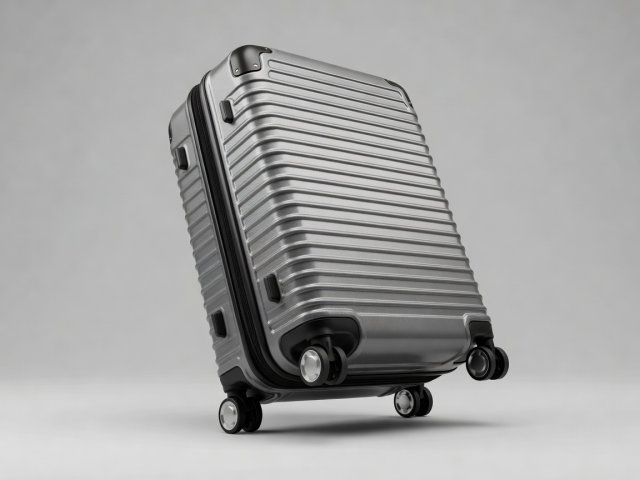
Hard-shell carry-on spinner displaying ribbed polycarbonate exterior, corner bumpers, and recessed dual caster wheels
Recessed wheel wells preserve usable interior height within a 55 cm limit.
GEOMETRY CHECK • WHEEL SUBTRACTION

Counting the Lost Centimeters

A cabin spinner measuring 55 cm tall overall typically loses 5.5 cm to 7 cm to caster height and another 1.5 cm to the top grab handle. That leaves roughly 46 cm of usable internal cargo height—nearly 8 cm shorter than an equivalent 55 cm frameless travel backpack.

Zipper Closures vs. Aluminum Latch Frames

Closure Type Typical Weight Impact Water & Pry Resistance Field Repairability
Single-Track #10 Coil Zipper Lightest (baseline) Moderate; vulnerable to ballpoint-pen puncture Slider replacement possible with basic pliers
Double-Coil Anti-Puncture Zipper +80 g to +140 g High resistance to splitting under heavy compression Requires twin-track replacement slider
Extruded Aluminum Clamp Frame (Zipperless) +450 g to +850 g Excellent gasketed rain seal and rigid corner alignment Bent frame rails difficult to straighten away from bench tools

Corner Reinforcement & Riveted Armor

Ninety percent of structural fractures occur at the four bottom wheel corners and the two top corners adjacent to the telescopic handle. External anodized aluminum or thick glass-filled nylon corner guards absorb glancing blows against aircraft cargo-belt guide rails. Crucially, inspect whether corner caps sit proud of the shell by 2 mm to 3 mm: oversized protruding caps can catch inside tight 20 cm airline sizer gates.

Four-Wheel Casters vs. Two-Wheel Recessed Rollers

Spinner wheels allow effortless lateral rolling down narrow aircraft center aisles (typically 43 cm to 48 cm wide between economy armrests), where pulling a two-wheeled case sideways clips passenger knees. However, four external swivel housings sit exposed on stalks, making them far easier to shear off on airport baggage diverters if gate-checked.

For rugged street approaches across cracked paving, two large 75 mm recessed inline-skate wheels tucked deep into the rear shell edge roll over obstacles that stall small 50 mm twin-spinner casters, while freeing roughly 4 liters of extra bottom corner capacity inside the shell.

Wheel Bearings & Tire Compounds

Cheap rigid plastic caster rims clatter loudly across tile and quickly flat-spot if dragged diagonally across asphalt. Seek soft high-durometer polyurethane (PU) treads bonded over nylon hubs with sealed steel ball bearings (such as Japanese Hinomoto Lisof Silent Run assemblies). Polyurethane dampens high-frequency rattle that otherwise loosens laptop screws inside the case.
Telescopic Handle & Interior Layout Trade-Offs

TROLLEY CHASSIS • MULTI-STAGE TUBING

Dual-Tube Aluminum vs. Wide Perimeter Frame

Standard twin-tube trolley assemblies occupy two parallel channels down the center of the rear compartment, forcing folded jackets around awkward troughs. Some modern carry-ons relocate wider flat aluminum handle rails out to the perimeter edges of the shell, producing an unobstructed flat packing floor with superior torsional stability when carrying a laptop tote perched on top.

MODULAR ACCESS • FRONT POCKET HINGE

Polycarbonate Front Tech Vaults

Cabin spinners fitted with a hinged front-lid pocket let you slide out a tablet or passport folder at TSA/security lanes without cracking the whole clam open in public. Note the volumetric trade-off: an internal front tech divider steals 4 liters to 6 liters from the main clothing cavity and adds ~350 g of extra zipper hardware.

REPAIR CHECK • SERVICEABILITY

Zippered Lining Access

Never buy a hard-shell case whose interior fabric liner is permanently glued to the plastic shell. A center maintenance zipper along the liner floor lets you tighten loose wheel-housing screws with a Phillips screwdriver or swap a damaged trolley mechanism in fifteen minutes without slicing the lining.