Category 01 • Soft-Sided Harness Architecture

Frameless vs Internal-Frame Cabin Packs

A travel backpack lives between two incompatible constraints: rigid airline sizer boxes demand stubby, boxy geometry under 55 cm tall, while comfortable load carriage requires torso-matched suspension stays and pelvic load transfer.

Why Height Caps Change Suspension Physics

Traditional alpine and backcountry hiking packs run 65 cm to 75 cm tall so load lifters can anchor well above the user's shoulders and direct vertical weight straight onto the hip belt. Cabin-compliant travel packs cannot exceed 55 cm in height—and personal-item packs must stay near 40 cm to 45 cm—leaving far less vertical span between the shoulder yoke and the iliac crest.

When a 52 cm pack is carried by a traveler with a 50 cm torso length, the shoulder strap anchors sit at or slightly below the top of the trapezius. Without stiff vertical stay geometry, load-lifter webbing merely pulls the upper corner of the bag forward into the neck without taking mass off the collarbones. That is why evaluating torso adjustment range (measured from the C7 vertebra down to the iliac crest) matters far more than total liter capacity.

Comparing Three Internal Structures

Travel packs fall into three mechanical tiers: unframed foam-pad packs, single-sheet HDPE framesheet packs, and perimeter spring-steel or aluminum-stay suspension packs.

  • Frameless EVA Foam Packs (26 L to 35 L): Typically weigh 750 g to 1,100 g empty. Ideal when strict 7 kg airline cabin weight rules apply, because the pack consumes minimal allowance. However, overstuffing rounds out the back panel into a convex pillow that pushes the center of gravity away from your spine.
  • HDPE Framesheet Packs (32 L to 40 L): A die-cut 1.5 mm polyethylene sheet keeps laptop sleeves flat and prevents sharp footwear heels from poking into your back. Tare weight sits near 1.25 kg to 1.5 kg. Suitable for 6 kg to 9 kg loads on rail transfers and short city walks.
  • Perimeter Wire or Dual-Stay Packs (38 L to 45 L): A tempered 3.5 mm spring-steel perimeter frame or twin 6061 aluminum bars create a rigid chassis that connects directly into a load-bearing hip belt. Although tare weight rises to 1.6 kg–1.9 kg, a 10 kg packed load feels significantly lighter over three kilometers on foot.
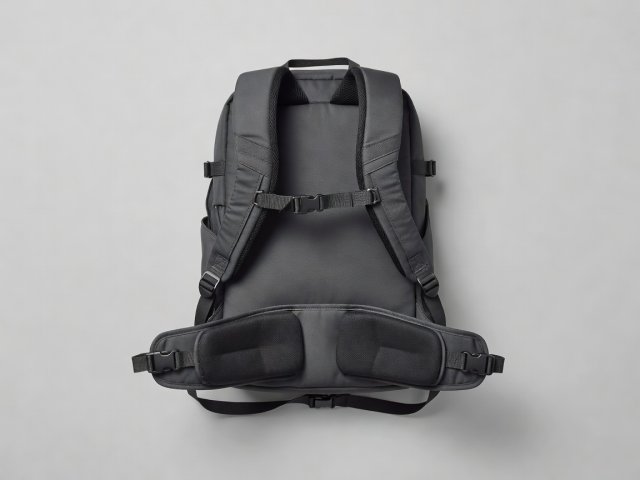
Structured carry-on travel backpack laid flat showing shoulder straps, sternum strap, and padded hip belt
Stowable hip belts prevent loose webbing tangles inside overhead luggage racks.
SIZING BENCHMARK • TORSO LENGTH

Matching Pack Frame to Torso Span

Measure along the spine from the bony C7 bump at the base of the neck down to the horizontal line connecting the tops of your hip bones. Short torsos (38–43 cm) need 45–48 cm packs; average torsos (44–49 cm) align well with 50–53 cm cabin packs; long torsos (50+ cm) require adjustable yokes so the hip belt does not ride across the ribcage.

Access Geometry: Clamshell vs. Panel-Loader vs. Top-Loader

How a bag opens dictates how fast you can extract a toiletry pouch at airport security or find clean socks in a dim sleeper train berth without unpacking onto the floor.

LAYOUT A • 180° FULL CLAMSHELL

Book-Style Suitcase Opening

A three-sided #10 zipper lays the lid completely flat, exposing a rectangular main cavity sized for modular packing cubes. Look for internal compression straps or a zippered mesh divider to hold clothing stacks in place when opening the pack upright on a narrow hotel luggage stand.

LAYOUT B • U-ZIP PANEL LOADER

Three-Quarter Front Access

The front panel opens in a deep U-shape while leaving the bottom bucket gusset intact. This keeps heavy footwear or a dopp kit anchored at the base of the pack even when unzipped vertically inside a crowded train aisle, reducing accidental yard-sale spills.

LAYOUT C • SPLIT-BOOK 50/50

Dual Equal Compartments

Splitting depth evenly down the center mimics a hard-shell suitcase. While tidy for separating clean shirts from laundry, dividing a 20 cm deep cabin pack into two 9 cm halves leaves neither side deep enough for bulky hiking boots or a thick DSLR cube.

Volume Reality Check: Why 40 L Packs Beat 40 L Rollers

Specification Metric 28 L Personal-Item Pack 35 L Compact Cabin Pack 40 L Max Cabin Pack
Typical External Dimensions 44 × 30 × 18 cm 50 × 33 × 20 cm 55 × 35 × 22 cm
Fits Budget Underseat Sizers Usually (check 40 cm strict gates) No (overhead bin required) No (overhead bin required)
Recommended Tare Weight 0.8 kg – 1.15 kg 1.1 kg – 1.45 kg 1.35 kg – 1.85 kg
Laptop Compartment Impact Suspended sleeve consumes ~3 L Rear-hinged pocket keeps flat access Side-zippered padded vault preferred
Practical Packing Window 2 – 4 days minimal kit 4 – 8 days multi-season 7 – 14+ days with layers

Laptop Sleeve Placement & Center of Mass

A 15-inch or 16-inch laptop weighs between 1.6 kg and 2.2 kg. Mounting that flat metal slab directly against the back panel puts its center of mass close to your spine, minimizing rearward leverage. Bags that place the laptop sleeve on the outer front face pull backward noticeably during stair climbs and expose the display to bin-door crush forces.

Always verify that the sleeve incorporates a "false bottom"—at least 2.5 cm of suspended clearance above the base seam—so setting the pack abruptly onto concrete train platforms never transmits shock straight into the hinge corner of the computer.

Ventilation vs. Abrasion at the Back Panel

Open-cell spacer mesh breathes better in humid summer terminals, yet coarse mesh surfaces abrade merino wool sweaters and linen shirts across multi-hour transit days. Smooth perforated EVA foam overlaid with slick nylon jersey or fine monofilament mesh balances airflow with low friction against delicate knitwear.

For frequent flyers facing strict 7 kg carry-on scales in Southeast Asia or Australia, compare backpack weights against our fabric denier and weight guide, or weigh whether a lightweight convertible duffel saves enough empty tare grams for an extra pair of shoes.